Prohibition on Killing One’s Own Kind
Interview with the VampireThe Prohibition on Killing One’s Own Kind is the defining criminal rule of the vampire communities encountered by Louis. It forbids a vampire from killing another vampire and makes such an act punishable by death. The rule gives the scattered undead population a minimal legal order, but it is also an instrument of power: knowledge of the rule turns Louis and Claudia’s hidden violence into a liability, allows Santiago to challenge them publicly, and ultimately makes their survival depend on concealment, escape, and preemptive destruction.
Definition and Enforcement
The rule is announced at the Théâtre des Vampires as the one offense for which vampires will hunt down and destroy one of their own. Santiago presents it as a crime whose penalty applies to any vampire anywhere who commits it, elevating the prohibition above local custom and making it a principle of collective vampire law. The language is absolute: the offense is not merely disapproved of, and it is not left to private revenge; it warrants pursuit and execution by the community.
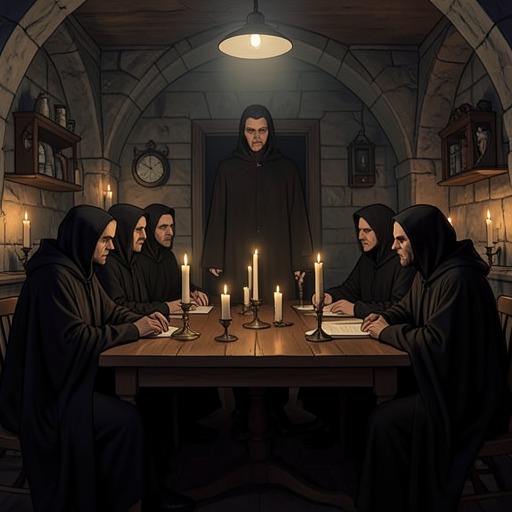
The rule’s enforcement is informal but unmistakably coercive. The theater vampires do not invoke a visible court, written code, or neutral adjudicator. Instead, they gather, watch, question, expose, and threaten. Santiago turns the rule into a public performance, placing his hand on Louis’s heart while asking whether he can identify the crime that means death. His questioning is designed to make accusation itself a spectacle. The law therefore operates through communal scrutiny and psychological pressure as much as through physical force.
The Rule at the Théâtre des Vampires
The prohibition becomes explicit when Claudia asks whether the theater vampires recognize any truly serious crime among themselves. The exchange first appears to dissolve into theatrical banter, with boredom called a kind of death, but Santiago abruptly changes the tone. He connects the rule to Claudia’s secrecy about the vampire who created her, implying that her concealed history may itself be evidence of a forbidden act. The room falls silent, and the gathered vampires turn their attention toward her and Louis.
Santiago’s accusation is deliberately indirect before it becomes direct. By emphasizing that Claudia should know the answer because she is secretive about her maker, he converts an abstract legal principle into a threat aimed at the pair. Claudia responds with laughter and theatrical defiance, then takes Louis by the hand and leaves. Her reaction does not disprove the accusation; it shows instead that she understands the danger and refuses to grant Santiago the authority to define her before the assembled group.
Armand’s conduct reveals another dimension of the law. He remains outwardly connected to the theater community while maintaining a more distant relationship to its displays of cruelty. He warns Louis that killing other vampires is exciting precisely because it is forbidden under penalty of death. The prohibition thus has a perverse attraction: it establishes the boundary that makes transgression thrilling. Armand’s warning is simultaneously legal advice, a recognition of the theater’s danger, and an acknowledgment that the law’s existence intensifies the appetite for forbidden violence.
Earlier Human Laws and Competing Norms
The vampire prohibition is placed against several human systems of judgment that also attempt to explain or punish violent death. After Paul’s death, Louis is questioned by servants, family members, police, and a priest because he had argued with his brother shortly before Paul fell from the gallery. No one possesses decisive proof, yet suspicion gathers around Louis through circumstance, rumor, and the social expectation that a concealed quarrel must have produced a crime. Human justice appears procedural only in fragments: witnesses are consulted, the police question Louis, and religious authority demands an account, but guilt is shaped by communal interpretation.
The priest supplies a competing religious explanation by declaring that Paul was possessed by the devil and that the devil had thrown him down the steps. His claim replaces uncertainty with dogma, converting a mysterious death into an accusation against supernatural evil. Louis rejects the priest’s shallow certainty and nearly kills him during the ensuing confrontation. This episode shows that the vampire law is not the only norm governing the narrative. Church doctrine, family authority, police inquiry, plantation hierarchy, and popular beliefs about possession all compete to name the source of violence and determine what response is legitimate.
The same instability appears when Emily’s corpse is exhumed. Morgan witnesses villagers driving a stake into the body, severing its head, and preparing to burn the remains because they believe vampires have caused a plague. The villagers’ actions constitute a form of popular anti-vampire law: they identify a contaminating threat, violate the grave, and perform bodily destruction as protection for the living. Their certainty is as violent as the vampires’ internal rule, but its evidence is sensory and ritual rather than judicial. The sight of the puncture wounds and the discovery of a body that appears unnaturally preserved become sufficient to authorize collective punishment.
Violations and the Problem of Proof
The rule depends upon secrecy because vampire society lacks a transparent method for establishing guilt. Louis and Claudia have killed Lestat, but the evidence of that act is hidden within their private history. At the Théâtre des Vampires, Santiago suspects that something is concealed about Claudia’s maker, yet suspicion is not immediately converted into open execution. The theater’s power lies in its ability to force disclosure while preserving uncertainty long enough to manipulate the accused.
The rule also becomes morally unstable because vampire violence is otherwise normalized. The theater vampires discuss their nightly kills with affected detachment and criticize one another for wasting opportunities to murder mortals. Human victims may be frightened, manipulated, or killed for amusement, while the killing of a vampire is treated as the cardinal crime. The law therefore protects the boundaries of the vampire group rather than expressing a universal prohibition against killing. It distinguishes between authorized predation upon outsiders and forbidden violence within the protected community.
This distinction explains why the rule feels both necessary and hypocritical. It can restrain internecine violence, preserve secrecy, and prevent the vampire population from destroying itself. At the same time, it establishes a hierarchy of lives in which mortals are available as victims and vampires are protected as legal persons. The prohibition is consequently an instrument of group survival rather than a general ethic of compassion.
Consequences for Louis and Claudia
Once Louis and Claudia are suspected of having violated the rule, their relationship to the theater changes from curiosity to danger. Louis recognizes that the vampires may be seeking evidence of guilt, and Armand advises him not to give them the proof they want. He urges Louis to use his supernatural power to conceal anxiety in public and to hold a single warning thought when facing Santiago or any other vampire. The advice treats emotional visibility as legal evidence: fear itself can expose the accused.
Armand’s attempt to rescue Louis demonstrates the rule’s practical severity. He can free Louis from confinement, but he says that he cannot save Claudia without provoking the other vampires and risking Louis as well. The law is enforced not only by individual hostility but by the collective structure of the theater. Even Armand’s authority has limits because an open intervention would unite the community against him. Louis refuses to leave Claudia behind, returns with Armand, and confronts the theater’s vampires rather than accepting a survival secured by abandonment.
The rule finally governs the theater’s response to the pair. Claudia is held by the theater vampires, while Louis’s escape does not release him from the legal danger created by her alleged crime. His later decision to burn the Théâtre des Vampires is therefore more than revenge. It is an attempt to destroy the institution capable of judging and executing them. Before dawn, he barricades the theater doors from outside, pours kerosene through the lower passages and cells, and sets the stage, curtains, chairs, and draperies alight. The prohibition’s threatened punishment is answered by an attack on the community that enforces it.
Significance
The Prohibition on Killing One’s Own Kind supplies the novel’s clearest image of vampire society as an organized, self-protective order rather than a collection of solitary predators. Its vocabulary of crime, pursuit, and death gives immortality a legal structure, but the structure is theatrical, secretive, and unequal. The theater turns law into spectacle; the spectators become potential executioners; and the accused must perform innocence while concealing the truth.
The rule also exposes a contradiction at the heart of vampire morality. The vampires condemn the destruction of their own kind while treating mortal death as entertainment, opportunity, or ordinary nourishment. Their law preserves a boundary between insiders and outsiders, not between violence and nonviolence. Louis’s resistance arises from his refusal to accept that boundary as morally sufficient: he remains troubled by killing even while the theater vampires celebrate it, and he experiences the prohibition less as a complete ethical system than as a coercive rule protecting a corrupt community.
Its final significance is therefore double. The law creates the conditions for vampire continuity by preventing internal slaughter, but its absolutism also produces concealment, intimidation, and retaliatory violence. By enforcing itself through fear, it drives Louis toward flight and the destruction of the theater. The rule meant to preserve vampire society becomes one of the forces that reveals its fragility and helps bring one of its most visible institutions to ruin.